
Key takeaways (read this first)
- Use the center letter in every word (minimum 4 letters).
- Find the pangram early—it often unlocks many more words.
- Build word families (prefix/suffix patterns) instead of random guessing.
- Use tools (Buddy/Grid) to spot what you’re missing, then practice without tools to improve.
Updated for 2026 search intent: beginner-friendly, tool-based improvement, and faster Genius progression.
What Is the Spelling Bee Game?
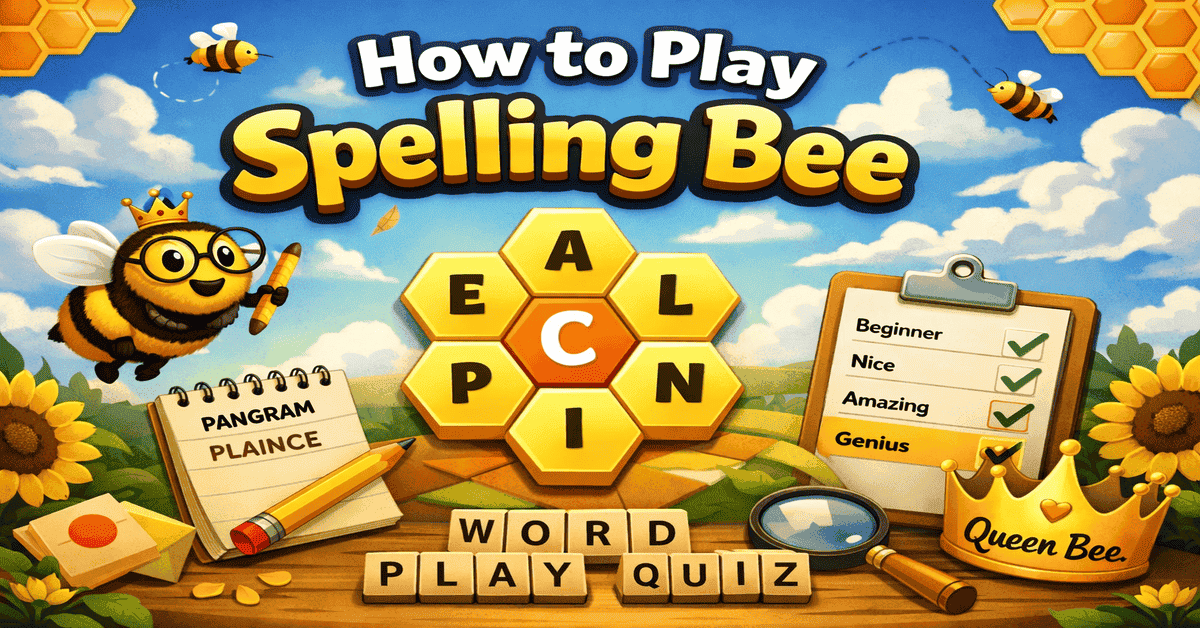
Spelling Bee is a daily word puzzle where you’re given 7 letters in a honeycomb. Your job is to make as many valid words as possible. The key twist: every word must include the center letter.
On spellingbeegame.us, you can play “Spelling Bee Unlimited” style puzzles to practice more than once per day, improve faster, and build pattern recognition.
Spelling Bee Rules (Simple + No Confusion)
- Words must be at least 4 letters.
- Every word must include the center letter.
- You can reuse letters as many times as you want.
- No proper nouns, hyphenated words, or offensive terms.
- Extra reward for finding the pangram (uses all 7 letters).
Scoring & Ranks: How “Genius” and “Queen Bee” Work
Most Spelling Bee versions use a points-based ranking system. Your goal is to climb the bar as you add valid words. The final badge—Queen Bee—usually means you found every word in that puzzle.
| Points | Rank | What it means |
|---|---|---|
| 0–4 | Beginner | You’re warming up—start with 4–5 letter basics. |
| 5–14 | Good | Found a few solid words; now build families. |
| 15–29 | Solid | Consistent progress—use endings and prefixes. |
| 30–44 | Nice | You’re seeing patterns—pangram hunt helps now. |
| 45–59 | Great | Word families + longer words push you up fast. |
| 60–79 | Amazing | Focus on 7–9 letter words and uncommon stems. |
| 80–99 | Genius | Strong solve—now clean up missing combinations. |
| All Words | Queen Bee | Perfect solve—every valid word found. |
What Is a Pangram (and Why It Matters)?
A pangram is a word that uses all seven letters at least once. It’s rare, gives a strong points boost, and often unlocks multiple related words (plurals aren’t usually allowed with “S”, but you’ll get lots of variants).
- Start by looking for a base word, then add a prefix/suffix.
- Try common builds: -ation, -ing, -able, -ment (when letters allow).
- Shuffle letters when you feel stuck—your brain spots new shapes.
Tools That Help You Solve Faster (and Learn More)
Spelling Bee Buddy
Gives hints based on what you’ve already found—use it to break “stuck loops” and learn new patterns.
The Grid
Shows possible word lengths and starting letters—perfect for spotting missing 4s/5s and chasing Queen Bee.
Shuffle
Resets your visual attention. Use it every time you hit a wall for 30 seconds.
Past puzzles
Reviewing old puzzles builds a “pattern library” in your head—this is how players improve fastest.
How to Start a New Puzzle (Step-by-Step)
1 Open spellingbeegame.us and load today’s puzzle.
2 Identify the center letter (it must appear in every word).
3 Start with easy 4-letter words to build momentum.
4 Expand into word families (add prefixes/suffixes).
5 Hunt the pangram early for a big boost.
6 Use Grid/Buddy if stuck, then finish without tools to learn.
Strategies Real Players Use to Reach Genius
- Look for endings like -ED, -ING, -TION (when letters allow).
- Build word families from a strong root (e.g., ACT → REACT → ACTION if possible).
- Try compounds and repeats (some puzzles allow fun builds like “deadhead”-style patterns).
- Use “no S” logic: rely on irregular plurals or alternate forms.
- Take a 2–3 minute break—many words appear after a reset.
Want an extra challenge after you hit Genius? Practice with: Hardest Spelling Bee Words.
Example: Using the Grid Like a Pro
Example letters: T, I, L, N, O, A, C with T in the center. The Grid might show you missing buckets like “4-letter words starting with L” or “5-letter words starting with T”. That tells you exactly where to focus.
- If “L + 4 letters” is missing, try: LA** patterns or vowel-first combos that still include the center letter.
- If “T + 5 letters” is missing, try common suffix builds like -tion (if available) or t + vowel starts.
- If there’s one pangram, search for a long word that touches every letter at least once.
Build Your 7-Day Practice Plan (Beginner → Better Fast)
Use this plan for consistent improvement without burnout. The goal is pattern learning, not endless guessing.
| Day | Time | Goal |
|---|---|---|
| Mon | 20 min | Reach “Solid” using 4–5 letter words first. |
| Tue | 30 min | Find the pangram early + build word families. |
| Wed | 15 min | Focus on 5-letter words; track repeats/patterns. |
| Thu | 30 min | Practice suffix hunts (-ING/-ED/-TION where possible). |
| Fri | 20 min | Use Buddy/Grid only when stuck (then learn why). |
| Sat | 25 min | Solve one puzzle without tools to test recall. |
| Sun | 10 min | Review misses and write 5 “patterns you learned”. |
Word Patterns You’ll See Again and Again
- Vowel-rich builds and swaps (when multiple vowels appear).
- Common prefixes/suffixes: RE-, UN-, -LESS, -ABLE (letter dependent).
- Double-letter opportunities (letter dependent) that create longer words quickly.
- Center-letter anchoring: once you find strong “anchors,” many words attach to them.
Final Buzz: How to Improve Without Overthinking
Spelling Bee is the thrill of the “Aha!” moment—when a word finally clicks, your rank jumps, and you start seeing patterns everywhere. If you want to level up fast in 2026, keep it simple: start small, hunt the pangram, and build word families.
- Breathe and reset when stuck.
- Always lock onto the center letter.
- Start with 4–5 letter words for momentum.
- Shuffle when your brain “freezes”.
Next step: Open today’s puzzle and aim for “Solid” in 15 minutes—then chase the pangram.
Frequently Asked Questions
Make valid words using the given letters—every word must include the center letter. Score points, find the pangram, and climb ranks.
Prioritize longer words, find the pangram early, and build word families. Use shuffles and short breaks to reset your attention.
A pangram uses all 7 letters at least once. It usually gives a strong points bonus and unlocks many related words.
Yes—letters can repeat as many times as needed as long as the word is valid and includes the center letter.
Leaving out “S” prevents easy plural spam and keeps puzzles challenging and balanced.
Many versions offer a free daily puzzle. For unlimited practice, use an alternative like Spelling Bee Unlimited.