
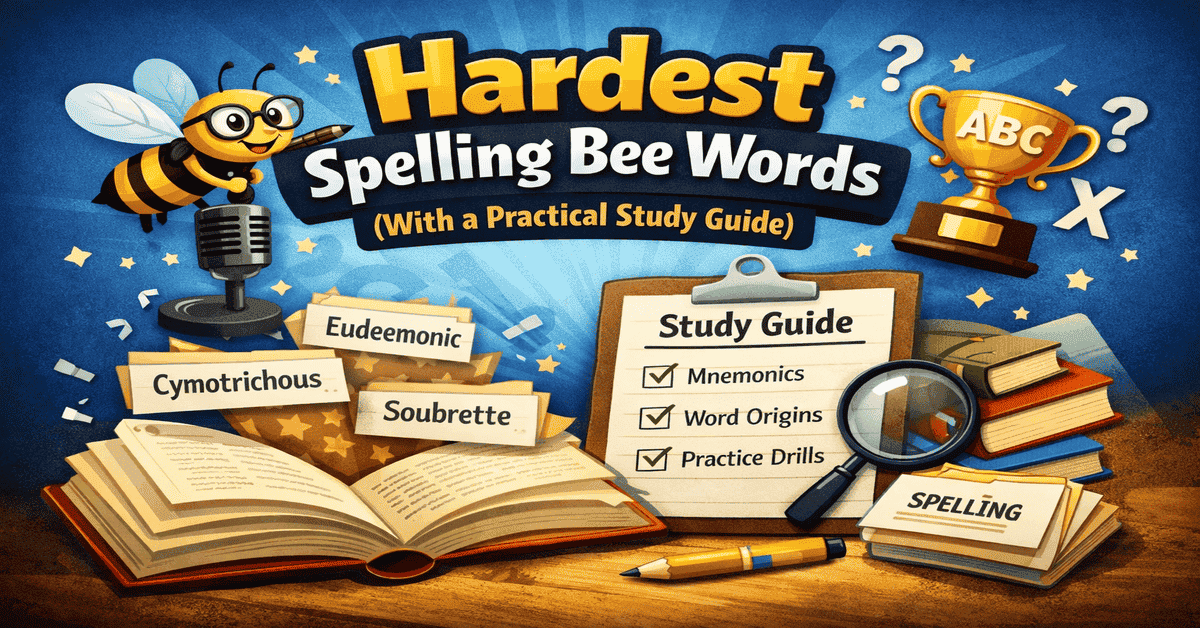
Why Some Words Are Truly the Hardest Spelling Bee Words
Hard words aren’t random. Most difficult spelling bee words fall into predictable categories—loanwords, silent letters, confusing vowel patterns, or unfamiliar roots. Once you learn the category, you can spell with logic instead of panic.
- Loanwords (French, Arabic, Latin, Hindi) that keep original spelling patterns.
- Silent letters and schwa sounds that hide real vowels and consonants.
- Pronunciation vs. spelling mismatches (what you hear isn’t what you write).
- Unexpected stress patterns and diacritics.
- Rare roots, prefixes, and suffixes.
Fast-Access Practice List: 40+ Hardest Spelling Bee Words
Study in mini packs (8–12 words). Review daily. Test weekly.
Word Packs by Trap Type
Loanwords
Identify origin first—French patterns predict spelling.
Silent letters
Slow syllables. Ask for pronunciation + origin.
Sound ≠ spelling
Ask for a sentence and origin—don’t trust sound alone.
Greek/Latin flags
Split into roots + affixes. Pieces are easier than monsters.
Micro-Glossary Method
- Word
- Definition
- Part of speech
- Origin
- Mnemonic
6-Week Roadmap
Baseline
Build your list + diagnose weak traps.
Spaced repetition
Daily recall + short pronunciation drills.
Auditory work
Record + replay tricky words.
Mock rounds
Timed spelling like real bees.
Error review
Fix the exact mistakes you keep making.
Final polish
Light review + confidence routine.
Spaced repetition setup
- One card per word (word → spelling + origin + mnemonic).
- Extra cards for difficult parts (clusters, vowels).
- Separate decks by trap type.
Pronouncer tips
- Ask for origin, definition, and a sentence.
- Repeat the word slowly before spelling.
- Don’t rush—steady spelling wins.
Contest day checklist
- Warm up (read aloud).
- 5 minutes breathing.
- Review top hardest words.
- Speak clearly and ask politely.
Quick action step: Pick 5 words today. Make mini cards. Review tomorrow, then add 5 more.
Frequently Asked Questions
Origins, silent letters, tricky vowels, uncommon affixes, and low exposure.
30–60 focused minutes daily beats random cramming.
Loanwords, Greek/Latin compounds, and short silent-letter traps.
French, Greek, and Latin are common; Arabic/Hindi loans can also be traps.